Tim Hollo: Living in the now and not yet
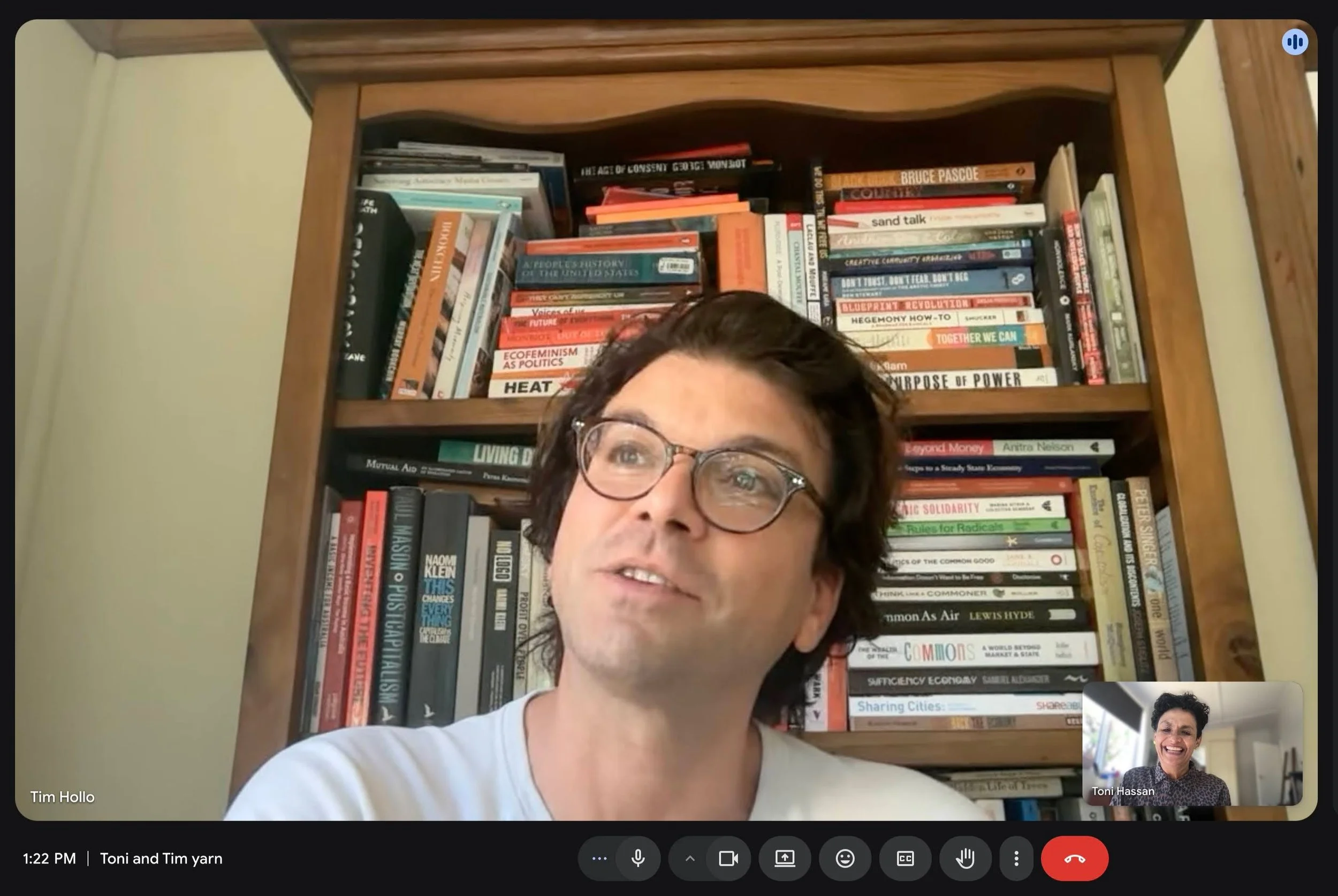
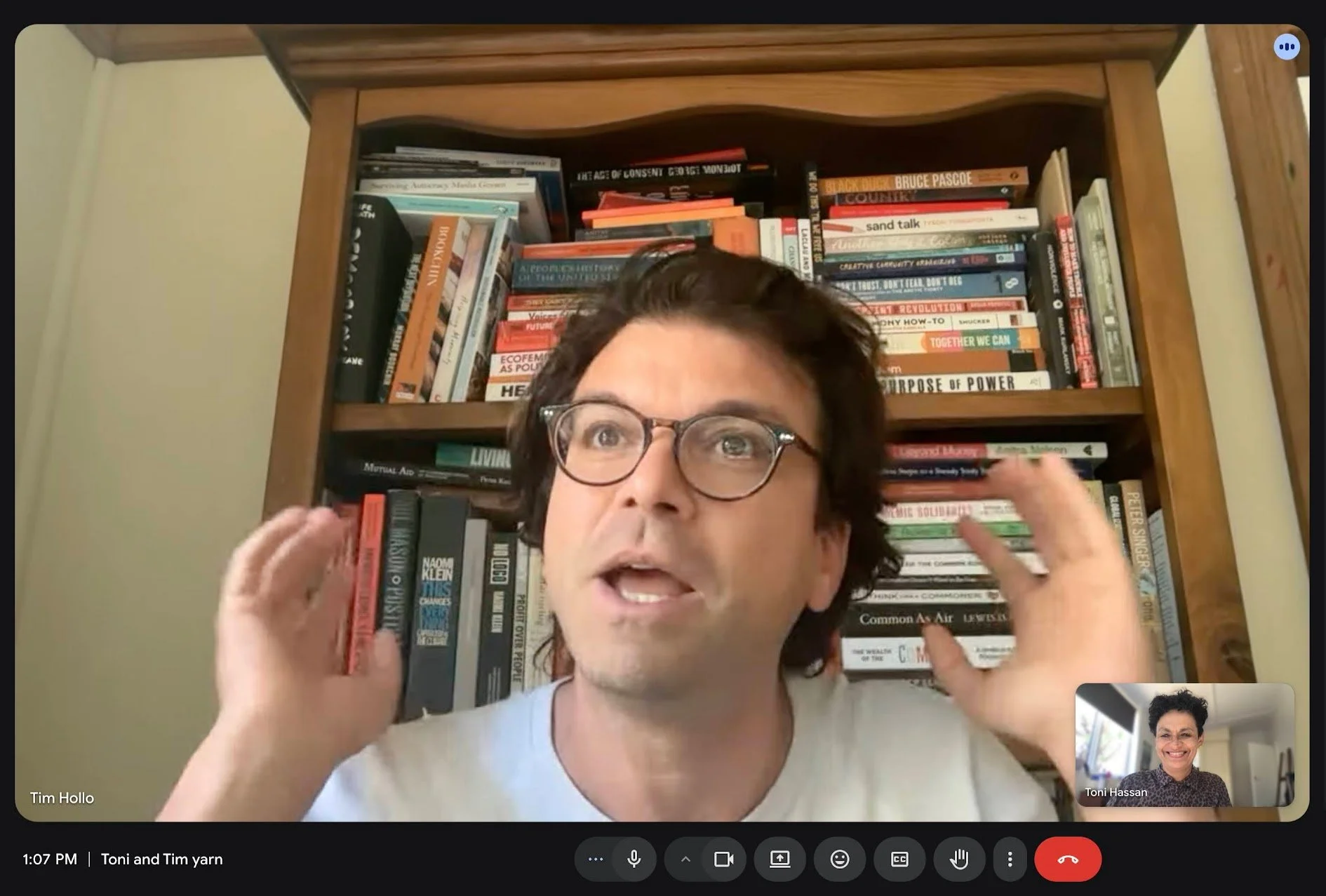
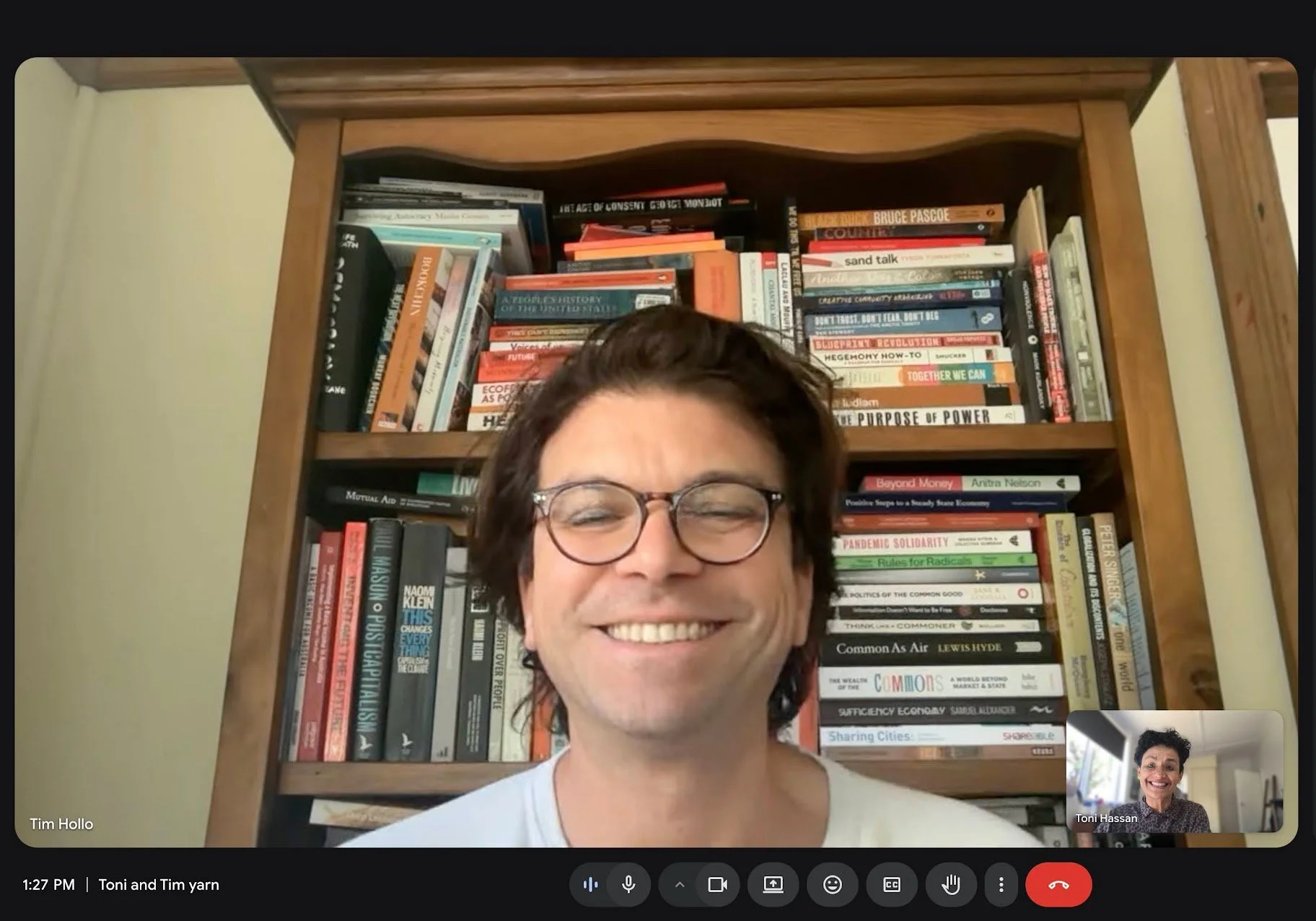
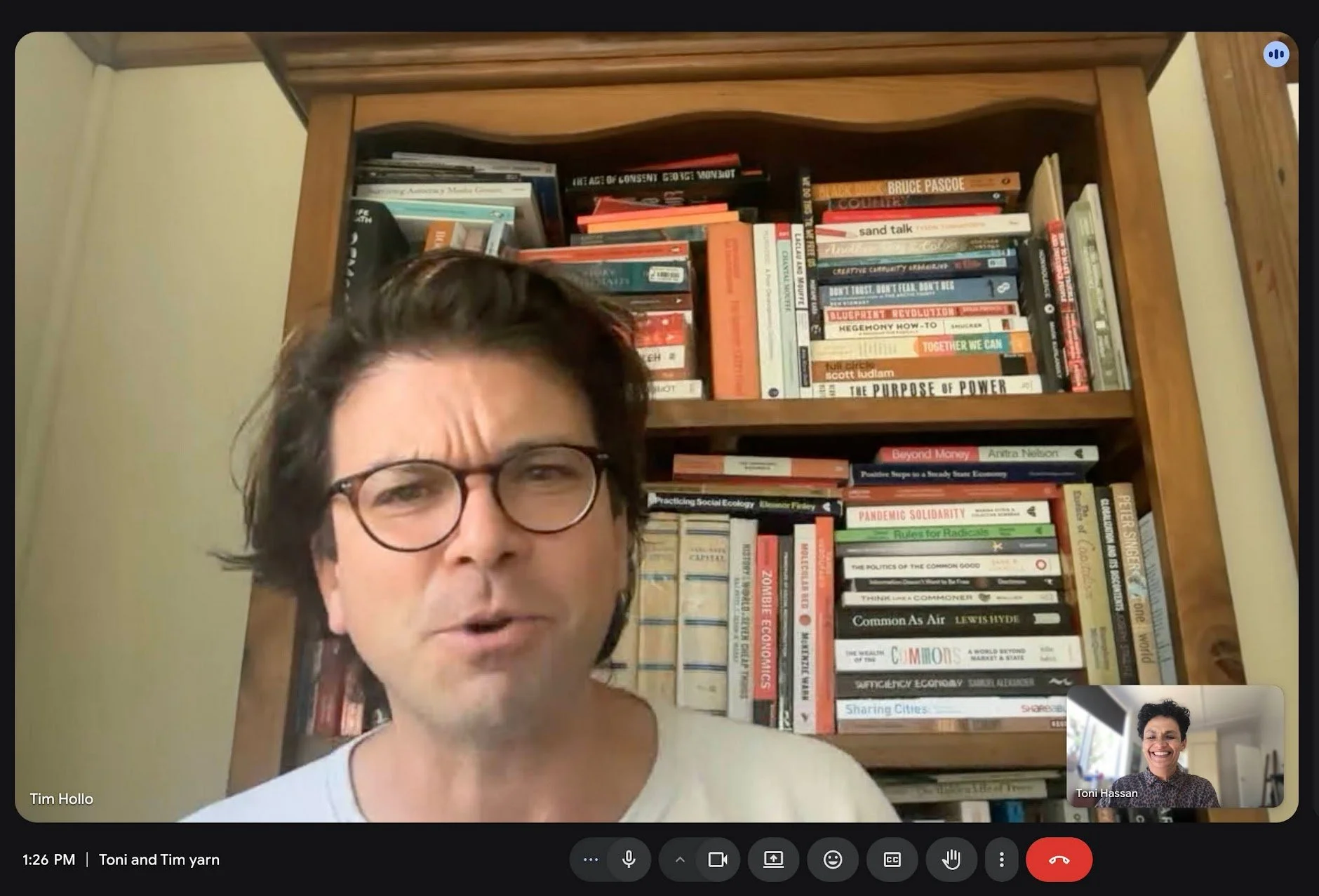
A conversation with Tim Hollo, friend and author of Living Democracy. How to live through profound change? We do it by ‘doing community!
Tim has begun a PhD to find space to make sense of change in the face of ecological collapse. We dip into the topics: climate change, the march of artificial intelligence, angst after Oct 7 and the Bondi attack, and the value of creating space for offline connections. As Tim, says, "We are people, fundamentally interdependent, who crave those offline places".
—-
Tim Hollo: I have reached a point of feeling like the institutions we rely on are so utterly broken, that I need to step away from them all together for a while. To be honest I am finding pathways that are very grassroots to be the most emergent spaces… The sands are moving, and so people are desperately looking for stability. Many are looking to systems which I identify as fundamentally unsuited to the polycrisis we face. I think we desperately need to find practices that enable us to let go of what is unhelpful as we forge our collective path to what comes next.
One thing that’s troubling me deeply at the moment on that front is the way that large language models enforce the status quo. They take what people already think and they digest it and spit it back out, when what we need is to find the space for emergence. We need to find the space to think what hasn't been thought before, and AI prevents us from doing that.
Hassan: What are you doing with artificial intelligence as an issue?
Hollo: I am being as much of a Luddite as I can, personally, not engaging with chat bots. I am turning AI off on email and word processing, acknowledging there's only so much you can do about it. On social media, when I see someone sharing something that they think is real and is clearly not, I try to intervene and talk to them about it. One area it has come up is in medical spaces, when a doctor asks, ‘Can I use AI to transcribe this?’ I say, ‘Oh, I’d rather you didn’t.’
Hassan: Yes. There are opportunity costs. It is another sign of our alienation.
Hollo: I am increasingly of the opinion, and I was when I wrote Living Democracy, that we are in at least early stages of some form of collapse. This AI boom is a harbinger of that. It's astonishing to me how ubiquitous it is, driven massively into all of the spaces that we are in online and in the tech world, by people we know do not have our best interests at heart. It's being forced upon us, and people are questioning it. At the same time as Trumpism is shining a light on the failure of so many of our democratic systems. I think we need this crisis of legitimacy so people can be ready and willing and able to challenge and start to grow on their own; start to step into our agency and say, ‘No, we won't do this.’
Hassan: What do you think is essential for that to happen, in the tool kit or what are the good seeds to plant?
Hollo: It involves creating spaces offline, in our communities, to do stuff together, and that is where my toolbox increasingly is. I just spent a week out bush, co-facilitating a decision-making and de-escalation stream at a training camp with Rising Tide. There were about 80 to 100 of us, camping out on a bush block, cooking together, cleaning up together, learning how to have conversations. Learning how to do all sorts of stuff together that just felt like, where I get hope, where I feel my cup is being filled, in spaces of deep community building, because it brings me back to a belief that I have, that people are fundamentally interdependent and want to create spaces where we can live that interdependence. It's so much better when we're out in nature as well, with the more-than-human-world, the world around us.
Hassan: We can't thrive living in our heads. Is it as simple as creating community by doing community?
Hollo: I love that. And building skills together. There’s been some beautiful stuff written about the resistance that we've been witnessing from afar in Minneapolis [where neighbours have formed groups to care for each other under occupation by US federal immigration agents]. The core of that resistance movement has been people cooking for each other, looking out for each other and just kind of knowing your neighbour, being friendly with your neighbours and saying [those immigrants], that family, they're going to need our support. We know who they are. We've got their back. They are not expecting a visible superstructure of organisation. No, it's invisible work. It's mycelium.
Hassan: What were you doing on your week away with Rising Tide?
Hollo: Ostensibly we came together to kind of learn explicit skills of how to do direct action better. But actually, what we were doing was just practicing the skills of being a good community and taking them back to our own homes around the east coast of Australia; with improved skills in how to have conversations, how to listen to each other better on a deeper level, in ways the algorithm trains us out of.
Hassan: You are a child of refugees and a grandchild of Holocaust survivors. I want to ask you about the Bondi attack and the war in Gaza; the effect on our politics. I'm wondering, your reflections on this.
Hollo: It’s got very personal. My musical band, which I started when I was 19, such a deep part of my entire adult life, with three of the four of us being Jewish, came apart. My brother was also a member of the band. I have a particularly strong critique of Israel, not only of its actions, but of its role in the Jewish community globally. It's been crafted in a way that overtakes every other form of Jewish identity. Jewish identity is so complex and nuanced and broad, and it should be, but Zionism has been made the core of it, and my brother and I are part of a growing group that disputes that.
A member of my band, one of my dearest friends, like a sister to me, she has always been very defensive of Israel. On October 7, she had a full trauma response to it, in such a way that, like so many in the community, she became unable to hear any criticism of Israel as anything other than exterminatory antisemitism. That relationship has completely come undone, so has my main musical project that has been so core to my identity. It’s imploded. It's emblematic of a complete rupture of a shared reality. That is one of the central themes of what I see as the collapse of politics as usual. Politics means the capacity to be able to talk across differences and find pathways through. That is what it fundamentally means. But politics today is people yelling at each across an abyss, not able to even conceive of the reality others are living in. This is what's happened in the Jewish community. It seems we cannot have a conversation about Israel. We cannot talk about it.
Hassan: Are there any green shoots? There were rabbis writing to Muslim leaders as brothers. They have been acts of kindness and forgiveness in the wake of Bondi. Will time make a difference?
Hollo: I think it needs to be more deliberate than time. Ironically, it seems to be easier on both sides (and I'm hesitant to use ‘both sides’) but it seems to be easier in some ways to talk across the grand difference between rabbis and imams, than it is to talk across differences within the communities. The greatest vitriol is against dissenting Jews from the mainstream Jewish community. I can only call it lateral violence; abuse hurled by the leadership of the mainstream Jewish Community, people including the special envoy, against those in the Jewish community who dare to say we need to actually hold Israel to account for its actions.
Hassan: You have written a submission to the Royal Commission on Antisemitism and Social Cohesion which was announced in the wake of the Bondi Beach terrorist attack. You say a Royal Commission is not the appropriate tool for the deep social issue of racism of all kinds, but in recognising it exists, urge engagement with the process in good faith. What are your key points?
Hollo: One, antisemitism is real and causes real harms, and it is too often weaponised to defend the indefensible in ways which leave the Jewish community dangerously exposed. Two, for many Jews, like myself, who are publicly critical of Israel, the antisemitism we face from non-Jews is dwarfed by the lateral abuse from other Jews, which itself often involves antisemitic tropes. I say that the single-minded focus of the mainstream leadership of the Jewish community in treating all criticism of Israel as antisemitic has blinded them to the very real threat of exterminatory antisemitism from the rising far right. I also say that the IHRA definition of antisemitism forms part of this blinding process and is damaging to social cohesion through its suppression of legitimate criticism of Israel. The Royal Commission should not use it.
Perhaps the clearest example of the unworkable nature of the IHRA definition in relation to the State of Israel is Prime Minister Albanese’s comment, regarding Israeli President Herzog, that “the Jewish community asked for their Head of State to visit”. This is clearly a breach of the definition, suggesting that the Jewish community is more loyal to Israel than to Australia. And yet, the statement was made supposedly in the spirit of having formally adopted the definition.
Hassan: You also point to the drivers of antisemitism, quoting German and American historian and philosopher, Hannah Arendt.
Hollo: Yes, in her The Origins of Totalitarianism, she sets out how social atomisation, injustice, a growing division between rich and poor, and general political instability, provide the perfect breeding ground in which antisemitism grows. The deliberate campaigns of othering, dividing the community, attacking immigrants and people of different religious and ethnic backgrounds, feed it further. It is far from controversial to suggest that we are currently living in a period of atomisation, division, inequality and instability, all of which are leading to the growth of far right ideology, including antisemitism. In this context, any political narrative that divides people on an ethnic or cultural basis presents a danger to the Jewish community. And we see far too much of that from politicians in the Coalition and One Nation, as well as in the media.
While I reject utterly the proposals from the Antisemitism Envoy to monitor and regulate the media, I believe it is important for the Royal Commission to consider the role of Sky After Dark, for example, in fomenting hate and division in the community, which leads ineluctably towards antisemitism.
I do not necessarily see evidence that the actions of the State of Israel themselves have substantially increased antisemitism per se. In countless conversations with Palestinian people, Muslim people, and white people involved in the Palestinian solidarity movement, I have seen a consistent and conscious differentiation between Israel and the Jewish people. While the anger at Israel’s actions often becomes hate, it is directed at the leaders of the nation state, and to members of the IDF, and to settlers, certainly. But it is not extended to all Jews. At least certainly not in the movement at large.
Regarding the internal antisemitism I referred to above – the lateral violence that non-Zionist Jews and those calling for peace have been subjected to – I suggest that it has two drivers. Much of it is driven by cognitive dissonance. For many people, brought up with both inherited and personal trauma, the idea of Israel as necessary for Jewish safety is a given. It is unquestionable received wisdom. If, for them, Israel is necessary, then any critique is difficult to accept. It becomes easier to see it as an antisemitic attack than as legitimate critique. I believe there is broad responsibility for this.
Where it becomes culpable, however, is where this trauma and cognitive dissonance has been turned into a deliberate political strategy to suppress dissent by targeting critics. The use of WhatsApp groups to coordinate attacks, the use of supportive media to target people, the use of social media to make broadsides (such as Mark Leibler’s infamous tweet calling Jews who criticise Israel “repulsive and revolting human beings”) – all these are, in my opinion, culpable.
Hassan: Tim, your submission also unpacks social cohesion. What do you think is meant by the term?
Hollo: It is a fraught and controversial term, but at its core, it surely means the ability to debate issues across difference. Without a wide range of opinions and perspectives, the term is meaningless. Unanimity is not cohesion. The suppression of dissent and criminalisation of protest, the banning of the use of words or phrases, attacks on legitimate debate in educational institutions, and campaigns of abuse targeting those who dare speak out, can only harm social cohesion and lead to more explosive unrest. The dangers to social cohesion do not come from protest, even vigorous protest, even protest that makes some people uncomfortable. Indeed, genuine social cohesion requires such protest, and it requires people to face their discomfort and consider the world from the perspective of others. The dangers to social cohesion come from the desire to suppress that dissent, and the use of coercive power to actually do so.
Antisemitism is rising. And it is complex. It has many forms and many drivers. Fundamentally, it is a social issue which cannot be adequately addressed by a Royal Commission, or really by government.
If there is one thing government can do, in my opinion, it would be to formally recognise the diversity of opinions across the Jewish community and beyond and use their good offices to attempt to heal the gaping wounds in the community. A government-sponsored restorative process would go a long way.
Hassan: Tim, you and I have talked about nonviolence over the years, a way of being and living that orients, in thought, word, and deed, towards integrating love, truth, and courage in individual and collective action. You've described what is distorting transformation. What’s getting in the way of realignment? And, any final thoughts on transformation in reference to discerning 'how to wait in the dark' between what you describe as ‘the no longer and the not yet’?
Hollo: What a beautiful way to frame that question. I think that, as we've discussed, for me the commitment to nonviolence is both about moral choice and about truly, deeply, thoroughly understanding interdependence. I mean by that not only the observation made by so many, including Dr Martin Luther King Jr, that what we do to another we do to ourselves, but also that what happens in the future emerges from what we do together in the present. If we use violence, what comes next will be violent. If we desire to live in a world of peace, we can only help that emerge by committing to nonviolence.
Transformation is emergence - it is a pathway to deep change that lets go of control, of coercion, of planning and determining from above, and seeks to cultivate the conditions for something to emerge. That is, at its heart, what Hannah Arendt is gesturing at with that fabulous phrase, "between the no longer and the not yet". When we live in the past, we find ourselves driven forward into a future in a direction we can't control. When we focus on a utopian future, we think we can control our path and soon discover that we can't. What is for us to do, then, is to live, together, today, consciously, determinedly, as well as we can, and forge our path collectively into the not yet.
I find that idea incredibly liberating. It lifts a tremendous weight from us. It brings us back to practice, to care, to the beauty in the world, to love, to life.
—
Living Democracy: An ecological manifesto for the end of the world as we know it (2022) is published by NewSouth. For more on the Royal Commission on Antisemitism and Social Cohesion or to make a submission, go to: https://asc.royalcommission.gov.au
This hybrid conversation, recorded by Zoom and by email, first appeared in EREMOS Magazine (Aug 2026 edition).
